






















In our first blog, Engineered for Durability, we explored how smart design choices create a strong foundation for reliability. But durability isn’t just engineered, it’s built into every step of production and proven through rigorous testing.
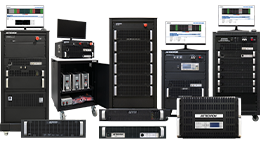
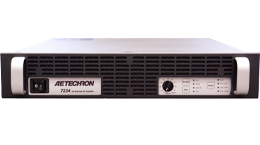
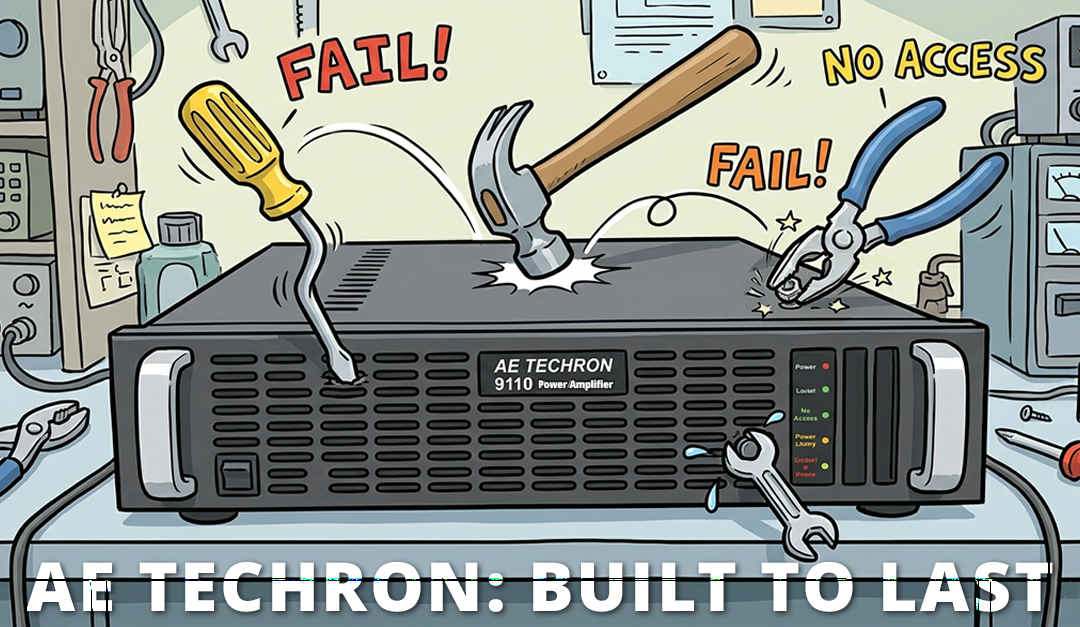
Every amplifier and EMC test system that AE Techron ships has already been inspected, validated, and pushed beyond normal operating limits. That’s what makes them so difficult to break in real-world use.
Built Right from the Start
Durability begins before assembly even starts. Incoming inspection ensures that only parts meeting exact specifications enter production. By catching issues early, we prevent small inconsistencies from turning into long-term reliability problems.
This disciplined front-end process eliminates variability and ensures every product starts with the same solid foundation.
- 100% inspection of all custom metal parts
- Verification using full-scale (1:1) drawings
- Checks for:
- Dimensional accuracy
- Bend direction
- Hole size and placement
- PEM hardware location and masking
Catching a bad part at this stage is far easier—and far more effective—than fixing a failure later.
Process-Driven Consistency
Once parts are approved, production is built around repeatability. Components are organized into kits that align directly with assembly steps, ensuring efficiency without sacrificing accuracy.
What truly drives consistency is the use of digital, picture-based work instructions across every workstation. These instructions standardize how each sub-assembly is built, eliminating guesswork and ensuring every unit is produced the same way.
- Over 400 sub-assemblies, each with its own work instruction
- Barcode scanning pulls up the correct instructions instantly
- Visual, step-by-step guidance at every workstation
- Continuous updates based on testing feedback
This closed-loop system ensures that lessons learned in testing directly improve how products are built.
Verified Before It’s Built
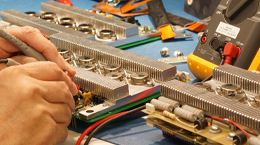
Before final assembly, the core electronics are already proven. Every printed circuit board (PCB) undergoes inspection and testing to ensure it performs as expected before integration into the full system.
This layered validation approach significantly reduces the chance of hidden defects making it into the final product.
- 100% of PCBs are tested or visually inspected
- Complex boards receive full electrical testing
- Many boards are tested multiple times before assembly
- First-pass yield consistently in the high 90% range
By the time assembly begins, most potential issues have already been eliminated.
Testing That Doesn’t Let Anything Slip
Final assembly is where everything comes together, and where everything is verified. Each amplifier goes through a complete, computer-controlled test sequence that ensures it meets all performance specifications.
The system guides the operator step-by-step and won’t allow progression until every parameter is within tolerance—removing subjectivity from the process.
- Calibration of ODEP, bias, gain, and DC offset
- Noise and distortion (THD) measurements
- Frequency sweeps and performance validation
- Overload and over-temperature protection checks
- Automated pass/fail enforcement before moving forward
This ensures that every unit leaving production performs exactly as intended.
Pushed Beyond Normal Limits
Durability isn’t proven under ideal conditions, it’s proven under stress. That’s why every product is subjected to testing that goes beyond normal operation to uncover hidden weaknesses.
These tests simulate extreme conditions to ensure long-term reliability in the field.
- HASS (Highly Accelerated Stress Screen): forces thermal shutdown to verify protection circuits
- Hi-Pot Testing: applies voltages well above operating levels to detect insulation breakdown
- Burn-In Testing: (8 hours total)
- Continuous operation near thermal limits
- Thermal cycling to expose weak connections and components
- Fallout rate of less than 1%
If a product is going to fail, we want it to happen here—not in a customer’s application.
Why It’s So Hard to Break Our Products
Durability isn’t a single feature, it’s the result of a disciplined, end-to-end process. From incoming inspection to final stress testing, every step is designed to eliminate variation, validate performance, and expose weaknesses.
- Every component is verified before assembly
- Every process is standardized and continuously improved
- Every unit is fully tested and stress-screened
Simply put, AE Techron amplifiers and EMC test systems are hard to break because we’ve already done everything we can to break them first—and made sure they keep working anyway.